
 Russian
Furnace Roof Skew Brick, also known as "half bricks" or "axe-shaped bricks", are wedge-shaped refractory bricks specifically designed for the arched roofs of electric furnaces and kilns. They are used for the fan-shaped circular masonry and keying of the furnace roof. With a trapezoidal cross-section from the large end to the small end, they achieve radial staggered joint self-locking and are suitable for arc-shaped structures.
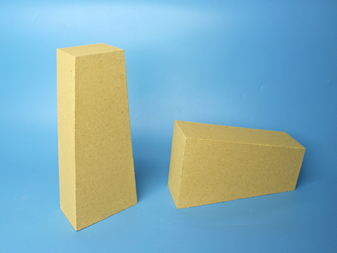
I. Features
1. Shape: Single-sloped wedge (right-angled trapezoid), with different inner and outer arc dimensions. The commonly used inclination angle is 15°–20°.
2. Material: Mostly made of high-alumina (with 50%-75% Al₂O₃), and there are also clay and corundum materials. The refractoriness is 1500-1750°C.
3. Specifications (YB/T5018):
D-4: 230×113×65/55mm (for 230mm-thick furnace roofs).
D-5: 300×150×65/45mm (for 300mm-thick furnace roofs).
T19/T20: 230×114×65/55mm (general-purpose axe-shaped bricks).
II. Functions and Applications
Circular masonry of furnace roofs: Used in the arc furnaces, ladle covers, and tunnel kiln arches, paired with straight bricks (D-1/D-2) to form a fan-shaped ring.
Keying and center bricks: At the final closing part of the arch roof, they are tightened by the wedge shape to prevent gas leakage and collapse in the hot state.
Around the electrode holes: In the electrode rings of arc furnaces, they can withstand high-temperature radiation and thermal shock.
III. Masonry Key Points
Radial staggered joints: The circumferential and radial joints should be staggered by at least 1/2 of the brick length to avoid through-joints.
Slope engagement: The wedge-shaped surface should face the furnace center, and high-temperature refractory mortar (with a binder content of ≥80%) should be used.
Uniform key bricks: Key bricks should be driven symmetrically from both sides to the center, inserted 2/3-3/4 of the brick thickness, and the driving force should be consistent.
Expansion allowance: Leave 2–3mm expansion joints per meter and fill them with ceramic fiber strips.
IV. Performance Advantages
Structural self-locking: The circumferential extrusion force of the wedge shape counteracts thermal expansion, making it more stable than straight bricks by over 30%.
Thermal shock resistance: The high-alumina matrix and low porosity (15%–20%) make it less likely to crack under rapid heating and cooling.
Good sealing: Precise dimensions (tolerance±0.3mm) ensure no gas leakage or fire escape in the hot state.
V. Common Problems and Countermeasures
Cracking: If the expansion joints are insufficient, widen them to 3mm; if the mortar strength is not enough, replace it with high-alumina fire clay.
Falling off: If the key bricks are not tightened, drive them tightly again evenly; if the staggered joints are insufficient, adjust the masonry direction.
Erosion: If the material grade is low, upgrade to high-alumina bricks with Al₂O₃≥70% or corundum bricks.
VI. Differences from Ordinary Bricks
Split arch bricks: Wedge-shaped, with different large and small ends, used for arc-shaped or arched roofs, with self-locking and sealing functions.
Straight bricks: Rectangular, with a uniform cross-section, used for straight walls or flat laying, without self-locking force.
