
 Russian
High Load-Softening Phosphate Firebrick (also known as High-Temperature Phosphate Brick / Phosphate Wear-Resistant Brick) is a non-fired chemically bonded refractory brick with core advantages of high load-softening temperature, excellent thermal shock resistance, and superior wear/alkali resistance, widely applied in high-temperature, high-abrasion zones such as cement kilns.
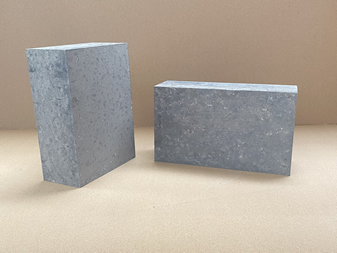
Raw materials: Special-grade and first-grade high-alumina bauxite clinker, combined with sillimanite or kyn4.ite (to resist expansion). The binder is aluminum dihydrogen phosphate (ordinary phosphate bricks use phosphoric acid).
Binder: Aluminum dihydrogen phosphate (ordinary phosphate bricks use phosphoric acid).
Manufacturing Process: Semi-Dry High-Pressure Forming →Low-Temperature Thermal Treatment (400–600°C) (non-fired process) , Chemically bonded product via polymerization of phosphate binders.
Core Physicochemical I"ndicators (Typical Values):
Item | High-Temperature Load-Softening Phosphate Brick | Conventional Phosphate Brick |
Al₂O₃ (%) | ≥80 | ≥75 |
Fe₂O₃ (%) | ≤2.5 | ≤3.5 |
Cold Crushing Strength (MPa) | ≥80 | ≥70 |
Load-Softening Temperature (°C) | ≥1400 | ≥1300 |
Bulk Density (g/cm³) | ≥2.8 | ≥2.7 |
Thermal Shock Resistance (1100°C water quenching, cycles) | ≥25 | ≥20 |
Performance Characteristics:
1.High Load-Softening Resistance: Maintains structural stability above 1400°C, with superior resistance to high-temperature creep compared to ordinary phosphate bricks.
2.Excellent Thermal Shock Resistance: Withstands rapid cooling/heating cycles without spalling, making it ideal for zones with severe temperature fluctuations.
3.Superior Abrasion Resistance: High hardness and resistance to material erosion ensure extended service life.
4.Enhanced Alkali Corrosion Resistance: Outperforms high-alumina and clay bricks in resisting alkaline vapor attack in cement kilns.
5.Unfired, Low Shrinkage: Low-temperature treatment minimizes high-temperature shrinkage, ensuring dimensional stability.
Primary Applications:
Cement Rotary Kilns:Transition zone, kiln inlet, nose ring, cooler (grate cooler) linings.
Lime Kilns & Vertical Kilns:High-temperature zones and wear-prone areas.
Other Applications:Electric furnace roofs, ladles, carbon rotary kilns, high-temperature sections of industrial boilers.
Differences from Ordinary Phosphate Bricks:
Binder: High-load-softening bricks use aluminum dihydrogen phosphate, while ordinary ones use phosphoric acid.
Load-Softening Temperature: High-load-softening bricks have a load-softening temperature above 1400°C, while ordinary ones are above 1300°C.
Raw Materials: High-load-softening bricks contain sillimanite and kyanite, which enhance high-temperature performance.
Price: High-load-softening bricks are slightly more expensive, but they have a longer service life and require less maintenance, resulting in lower overall costs.
