
 Russian
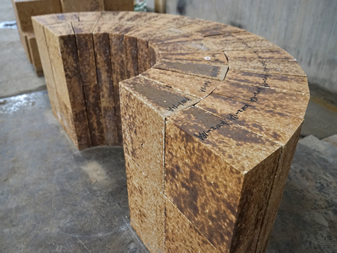
Customized refractory bricks are a specialized production service that caters to the requirements of special kiln structures, complex operating conditions, or non-standard size needs. It offers customized production in terms of materials, specifications, shapes, and performance indicators, aiming to solve the problems that standard bricks cannot adapt to.
I. Advantages of Customization
- Precise Adaptation: It can match irregularly-shaped furnace bodies, special angles, and complex structures (such as arc-shaped, wedge-shaped, conical, L-shaped, and burner bricks). For example, in a kiln with an arc-shaped inner wall, custom-made arc-shaped refractory bricks can fit perfectly, ensuring the integrity of the furnace structure.
- Performance Optimization: Formulas are customized according to temperature, chemical erosion, thermal shock, and mechanical stress to improve the service life and energy-saving effect. For instance, in a high-temperature and highly corrosive environment, a special formula can be designed to enhance the corrosion resistance and thermal stability of the bricks, thus extending their service life.
- Reduced Loss: It avoids on-site cutting, improving the masonry efficiency and the sealing of the lining. When using standard bricks, on-site cutting may lead to uneven edges and waste of materials. Customized bricks can be directly used for masonry, saving time and materials.
II. The Whole Customization Process (6 Steps)
1. Requirement Communication
- Provide Operating Conditions: Furnace type, maximum/operating temperature, atmosphere, contact medium, thermal shock frequency, and mechanical load. For example, in a steel-making electric arc furnace, the high-temperature environment, the type of slag, and the frequency of thermal shock need to be clearly stated.
- Clarify Parameters: Material, size (length×width×height/angle/holes), quantity, delivery date, and acceptance criteria. For custom-made bricks with special angles, the specific angle value must be accurately provided.
- For special-shaped bricks, drawings or on-site survey data are required. If a customer needs a unique L-shaped brick, detailed drawings or on-site measurement data can help the manufacturer understand the exact shape and size requirements.
2. Solution Design
Engineers select materials, optimize the structure, and plan the molds. They consider the specific requirements of the customer and choose the most suitable materials and structural designs.
Issue a technical solution and a quotation (a mold-opening fee of at least 2000 yuan is required for special-shaped bricks). The technical solution should include details such as the material composition, manufacturing process, and expected performance of the bricks.
3. Mold Making
Standard bricks use general molds; special-shaped bricks require the production of dedicated molds, which will be manufactured after confirmation. For example, a standard rectangular brick can use a commonly available mold, while a unique conical brick needs a specially designed mold.
4. Production and Manufacturing
The process includes raw material procurement, ingredient mixing, kneading, molding, drying, high-temperature firing, and inspection. Each step is crucial to ensure the quality of the bricks. For example, proper ingredient mixing can ensure the uniform distribution of various components in the bricks, and high-temperature firing can endow the bricks with the required physical and chemical properties.
5. Quality Inspection
Inspect dimensional accuracy, appearance, refractoriness, compressive strength, thermal shock stability, and chemical composition, and issue a report. This comprehensive inspection can ensure that the bricks meet the specified quality standards. For example, the refractoriness test can determine whether the bricks can withstand the high-temperature environment of the kiln.
6. Delivery and Service
Deliver the goods and provide masonry guidance. Some manufacturers can also undertake the construction work. After the bricks are delivered to the customer, professional guidance can help the customer complete the masonry work correctly, and on-site construction services can save the customer's time and effort.
III. Customizable Dimensions
1. Material Customization (Selected by Operating Conditions)
Material Type | Refractory Temperature | Key Characteristics | Typical Applications |
Clay Brick | ≤1400°C | Low cost, moderate thermal shock resistance | Heating furnaces, flue ducts, general-purpose kilns |
High-Alumina Brick | 1300–1700°C | High alumina content, corrosion resistance, high strength | Blast furnaces, hot blast stoves, electric furnace roofs, cement kilns |
Silicon-Mullite Brick | 1500–1650°C | Wear resistance, alkali resistance, excellent thermal stability | Cement kiln transition zones, coolers |
Corundum Brick | 1700–1900°C | High purity, extreme slag resistance, high-temperature stability | Glass furnaces, chemical reactors, high-temperature kiln furniture |
Lightweight Insulating Brick | 1000–1500°C | Low density, low thermal conductivity, energy-saving | Kiln back lining, thermal insulation layers |
2. Shape and Size Customization
- Standard Sizes: Common T3 brick (230×114×65mm), with minor adjustments to thickness and width possible.
- Custom Shapes: Wedge, cone, arc, knife, axe, burner bricks, fan-shaped, with grooves or holes, and other complex structures.
- Size Range: Thickness 45-95mm, single weight 2-80kg (high-alumina), length-to-width ratio≤1:5.
3. Performance Customization
- Chemical Composition: Customization of Al₂O₃, SiO₂, and additive ratios.
- Physical Properties: Refractoriness, Compressive strength at room temperature and high temperature, Thermal shock stability, Bulk density, Porosity, Thermal conductivity.
- Special Treatments: Surface coatings, anti-penetration, spalling resistance, alkali resistance, etc.
IV. Key Points for Customization
- Drawings/Data: For custom-shaped bricks, precise drawings (with dimensions, angles, and tolerances) must be provided.
- Mold Costs: Custom-shaped bricks require dedicated molds, and the cost is included in the total. Larger orders can help spread the mold cost.
- Minimum Order Quantity (MOQ): Manufacturers typically have MOQs, which are higher for custom-shaped bricks.
- Lead Time: Including design, mold making, and production, the lead time is generally 7-30 days.
- Inspection: Dimensions and performance are inspected according to the contract and national standards (eg, GB/T2988, GB/T2992).
V. Custom Services by Zhengzhou Kewei Refractories
We undertake the customization of all types of shaped and special-shaped refractory bricks, and provide one-stop solutions from design to construction.
We support processing based on provided drawings, on-site mapping, material optimization, and mass production.
We provide inspection reports and masonry guidance, and our products are suitable for industries such as steel, cement, chemical, glass, non-ferrous metals, and power.
